Putin Attempts to Downplay Kerch Bridge Damage Following Ukrainian Strikes
The Russian leader commented on the critical infrastructure damage in Crimea, denying its military role and attempting to reassure the public despite significant logistical failures.
 🚌Transport
Photo: UNIAN
Key points
- Putin described the bridge destruction as "serious damage," avoiding acknowledgment of the disaster's scale.
- The November 17 attack destroyed a 270-meter arch and blocked shipping lanes.
- The railway section was disabled following a secondary strike with Neptune missiles on November 19.
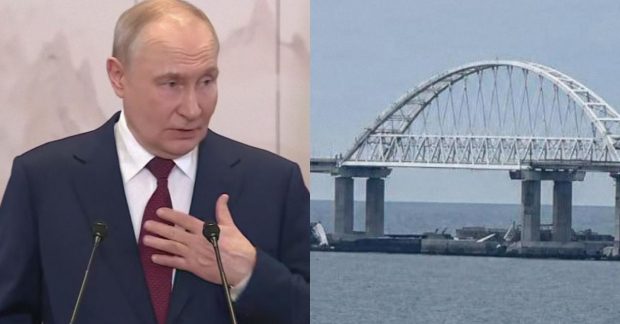
During a press conference at the APEC summit in China, Vladimir Putin was forced to publicly address the consequences of recent attacks on the bridge across the Kerch Strait. Despite obvious large-scale destruction, the Russian leader attempted to shift focus, labeling the object's condition as "serious damage" rather than total failure. He expressed confidence that the structure could be restored, though he provided no specific timeline for the repairs.
According to available data, on the night of November 17, Ukrainian forces utilized a wide range of weaponry, including missiles and various drone models such as "Neptune," "Palyanytsia," and "Sichen." The attack resulted in the complete destruction of the supporting arch, causing a 270-meter section of the roadway to collapse into the sea. This not only halted vehicle traffic but also blocked the only navigable corridor between the Sea of Azov and the Black Sea.
Manipulations and the Reality of Logistics
In his statements, Putin divided the structure into road and rail sections, claiming that rail service had supposedly already been restored. However, he omitted the fact that the railway line had been operational for less than 24 hours between two consecutive attacks. Furthermore, the Russian leader once again asserted the bridge's exclusively civilian nature, denying that it was used to transport fuel or ammunition for occupying forces.
The Ministry of Defense of Ukraine refutes these claims, emphasizing the bridge's strategic importance for supplying groups in the south. Following a repeat attack on November 19, where "Neptune" missiles struck the railway section, this logistical route effectively ceased operation. The enemy is now forced to rely on a land corridor along the front line, where military columns become easy targets for Ukrainian drones.
"Modern precision strike weapons make it possible to do this quickly," Putin stated, appearing confused by the terminology regarding restoration capabilities.
Currently, the situation surrounding the Kerch crossing remains tense. The lack of stable rail communication creates a critical resource deficit for the Russian army, directly impacting the intensity of combat operations in the southern direction.
Source UNIAN — unian.ua/world/putin-namagayetsya-primenshiti-shkodu-yaku-ukrajinsk… ↗
Read next
 🏙️City
Icy roads: meteorologists warn of danger on November 25
The Ukrainian Hydrometeorological Center has issued a Level 1 weather alert due to icy road conditions in Kyiv and the surrounding region.
 💼Economy
Putin threatens retaliation for attacks on Russian oil refineries
Vladimir Putin claimed that Ukraine continues to target Russian refineries despite US requests, promising a response.
 👥Society
The LEGO design secret: why minifigure head holes save lives
The small hole in a LEGO minifigure's head serves a crucial safety function beyond just design.
 💼Economy
How to prepare for the New Year holidays in Pryluky wisely: saving tips
Preparation for the New Year holidays is often accompanied by significant expenses. Experts recommend planning a budget and avoiding impulsive purchases to save money.
 🏛️Politics
Debate over accountability of anti-corruption bodies: absence at the parliamentary commission
Heads of NABU and SAP missed a parliamentary commission meeting due to foreign business trips, sparking a debate on the priority of parliamentary oversight.
 🛡️Security
Latvian President forecasts a turning point in the war by 2027
Edgars Rinkēvičs believes that if Ukraine maintains its resilience and international pressure on Russia increases, next year could prove decisive.